Heavy-Duty Electric Chain Hoist: How to Choose the Right Capacity for Industrial Lifting
August 14, 2026
Choosing a heavy-duty electric chain hoist is an important decision for factories, warehouses, construction projects, steel plants, shipyards, and other industrial applications. The correct hoist should not only match the required lifting capacity but also meet the requirements for lifting speed, lifting height, working frequency, installation method, power supply, and operating environment.
For buyers comparing different electric hoists, understanding these factors before ordering can help avoid selecting equipment that is either underpowered for the application or unnecessarily oversized.
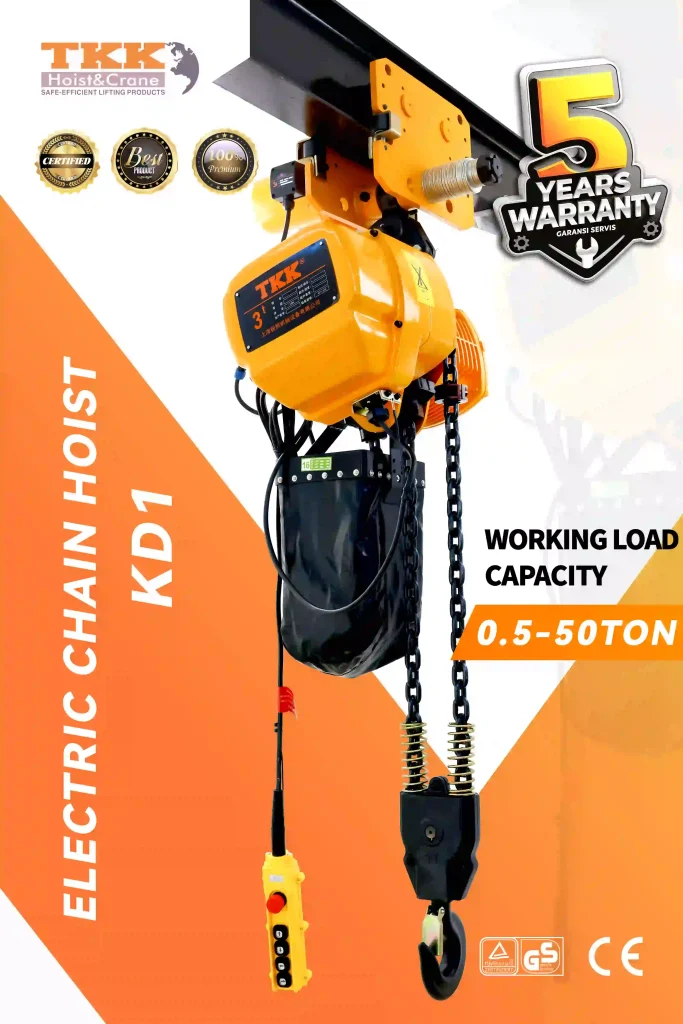
This guide explains the key factors to consider when selecting a heavy-duty electric chain hoist and introduces the TKK KD1 Electric Chain Hoist as an industrial lifting solution.
What Is a Heavy-Duty Electric Chain Hoist?
A heavy-duty electric chain hoist is an electrically powered lifting device designed to raise and lower loads using a high-strength load chain.
Compared with manual chain hoists, electric chain hoists reduce manual effort and improve lifting efficiency. They are widely used for material handling, machinery installation, production operations, equipment maintenance, and other applications where repeated lifting is required.
A suitable industrial electric chain hoist normally combines a lifting motor, gear transmission system, load chain, brake, limit switches, control system, and hook assembly to provide controlled and reliable lifting.
For demanding applications, buyers should look beyond the lifting capacity and evaluate the complete configuration.
1. Start With the Required Lifting Capacity
Lifting capacity is the first specification to determine when selecting an electric chain hoist.
Depending on the application, electric chain hoists may be used for loads ranging from several hundred kilograms to many tons.
The required capacity should be based on the maximum load that will be lifted during normal operation.
For example:
- 0.5–1 ton: Workshops, maintenance, light material handling, and equipment installation
- 1–3 tons: Manufacturing plants, warehouses, assembly lines, and general industrial lifting
- 3–5 tons: Heavy material handling, machinery installation, and industrial production
- Above 5 tons: Specialized heavy-duty applications requiring a higher-capacity lifting configuration
Do not select a hoist only according to the heaviest load that might occasionally appear. Consider the normal working load, lifting frequency, load characteristics, and supporting structure when determining the appropriate capacity.
For projects requiring special lifting capacities, the final configuration should be confirmed with the manufacturer according to the actual application.
2. Consider Lifting Height
Lifting capacity is not the only important specification. The required lifting height also affects the hoist configuration.
Before ordering, determine:
- Required lifting height
- Maximum hook position
- Minimum hook position
- Available headroom
- Installation space
- Required load chain length
A standard lifting height may be suitable for a workshop or warehouse, while production facilities and industrial crane systems may require a customized lifting height.
Providing the required lifting height when requesting a quotation allows the manufacturer to prepare the appropriate load chain configuration.
3. Choose the Right Lifting Speed
Lifting speed affects productivity and operating efficiency.
A single-speed electric chain hoist can be suitable for general lifting operations where precise positioning and variable lifting speeds are not critical.
A dual-speed electric chain hoist provides greater flexibility. The higher speed can be used for general lifting, while the lower speed allows more controlled positioning of the load.
The right choice depends on how the hoist will be used.
For example:
General material handling:
A standard lifting speed may provide sufficient performance.
Frequent production operations:
A higher lifting speed may improve handling efficiency.
Precision positioning:
Dual-speed operation can provide better control when positioning equipment or materials.
The TKK KD1 series is available with single-speed and dual-speed configurations to accommodate different industrial lifting requirements.
4. Consider Working Frequency
Working frequency is particularly important for industrial buyers.
A hoist used occasionally for maintenance does not have the same requirements as a hoist operating repeatedly throughout a production shift.
Before selecting an electric chain hoist, consider:
- Lifting cycles per hour
- Operating hours per day
- Load frequency
- Average load
- Maximum load
- Required duty level
Higher-frequency applications place greater demands on the motor, brake, gears, chain, and electrical components.
For continuous or demanding industrial applications, the hoist configuration should be selected according to the actual working conditions rather than capacity alone.
5. Check the Installation Method
Electric chain hoists can be used in different installation configurations.
Depending on the application, the hoist may be installed as a fixed lifting unit or combined with a trolley for horizontal movement along an I-beam.
Common applications include:
- Fixed lifting stations
- Monorail systems
- Overhead cranes
- Bridge cranes
- Gantry cranes
- Workshop lifting systems
- Production line material handling
The supporting beam and installation dimensions should be confirmed before purchasing.
For trolley-mounted applications, the I-beam width is also an important specification.
6. Check the Power Supply
International buyers should always confirm the required power supply before ordering.
Important electrical specifications include:
- Voltage
- Frequency
- Phase
- Motor power
- Control voltage
The standard configuration of the TKK KD1 series is based on 3-phase 380V, 50Hz, while custom voltage configurations are available according to project requirements.
The control system can also be configured with 24V, 36V, or 48V control voltage.
Providing the correct electrical requirements at the quotation stage helps prevent compatibility problems during installation.
7. Consider the Working Environment
The operating environment can have a significant impact on electric hoist selection.
Industrial lifting equipment may operate in:
- Manufacturing plants
- Warehouses
- Workshops
- Construction sites
- Steel plants
- Shipyards
- Mining operations
- Equipment maintenance areas
- Material handling facilities
For dusty or humid environments, protection of the motor and electrical components becomes especially important.
The TKK KD1 Electric Chain Hoist features an IP55 protection rating, providing protection against dust ingress and water from common industrial exposure.
For particularly demanding environments, buyers should provide detailed working conditions so the manufacturer can confirm whether additional protection or customization is required.
8. Pay Attention to the Load Chain
The load chain is one of the most important load-bearing components of an electric chain hoist.
A high-strength alloy steel load chain should provide adequate strength, wear resistance, and durability for the intended lifting application.
The required chain diameter and number of chain falls vary according to the hoist capacity and configuration.
For this reason, buyers should not select a load chain independently. The chain specification should match the complete hoist configuration and rated lifting capacity.
The TKK KD1 series uses high-strength alloy steel load chains designed for industrial lifting applications.
9. Gear System and Motor Performance Matter
The lifting motor and gear transmission system directly affect lifting performance.
A high-efficiency motor provides the driving power required to lift the load, while a properly designed gear system transfers motor torque smoothly to the lifting mechanism.
The TKK KD1 Electric Chain Hoist uses:
- High-efficiency copper motor
- Precision heat-treated gears
- High-strength alloy steel load chain
- Automatic upper and lower limit switches
- Pendant control system
These components work together to provide stable lifting performance for industrial material handling.
10. Safety Features Should Not Be Overlooked
Safety should always be considered when selecting lifting equipment.
Important features may include:
- Upper limit switch
- Lower limit switch
- Reliable braking system
- Low-voltage control
- Appropriate electrical protection
- Emergency stop function where applicable
- Properly rated lifting components
The TKK KD1 Electric Chain Hoist incorporates upper and lower limit switch protection. When the hook reaches its defined travel limit, the system can stop the motor to help prevent excessive chain travel.
However, the hoist is only one part of a complete lifting system. The supporting structure, lifting accessories, installation, inspection, and operation should also meet applicable safety requirements.
TKK KD1 Electric Chain Hoist for Industrial Applications
For buyers looking for a heavy-duty electric chain hoist for industrial material handling, the TKK KD1 Electric Chain Hoist provides a flexible configuration for different lifting requirements.
The KD1 series offers:
- Capacity options from 0.5 ton upward, with higher-capacity configurations available according to requirements
- Single-speed and dual-speed options
- High-strength alloy steel load chain
- High-efficiency copper motor
- Precision heat-treated gears
- Automatic upper and lower limit switches
- IP55 protection
- Waterproof pendant control
- 3-phase 380V 50Hz standard power supply
- 24V / 36V / 48V control voltage options
- Custom voltage and lifting configurations
- CE / ISO quality certifications
The KD1 series can be used in factories, warehouses, workshops, construction projects, steel plants, shipyards, mining operations, production lines, and general industrial material handling.
View the complete TKK KD1 Electric Chain Hoist specifications:
TKK KD1 Electric Chain Hoist – 0.5 Ton to 50 Ton
How to Choose the Right Electric Chain Hoist
Before requesting a quotation, prepare the following information:
- Lifting capacity: What is the maximum load?
- Lifting height: How high does the load need to be lifted?
- Lifting speed: Is single-speed or dual-speed operation preferred?
- Working frequency: How often will the hoist operate?
- Installation: Fixed type, trolley-mounted, or crane-mounted?
- Power supply: What voltage, frequency, and phase are required?
- Working environment: Indoor, outdoor, dusty, humid, or other special conditions?
- Quantity: How many units are required?
- Special requirements: Custom lifting height, voltage, trolley, control system, or other specifications?
Providing these details allows the manufacturer to recommend a suitable configuration and prepare a more accurate quotation.
Why Work With an Electric Hoist Manufacturer?
Buying directly from an experienced electric hoist manufacturer can provide advantages beyond the product itself.
A professional manufacturer can help buyers:
- Select the appropriate lifting capacity
- Confirm technical specifications
- Recommend suitable configurations
- Provide customized voltage and lifting height
- Support trolley or installation requirements
- Provide product documentation
- Arrange factory inspection and testing
- Support spare parts and after-sales requirements
For international industrial projects, clear technical communication before production is particularly important.
Conclusion
Selecting a heavy-duty electric chain hoist requires more than comparing prices or choosing the largest available capacity.
The right solution should match the lifting capacity, lifting height, lifting speed, working frequency, installation method, power supply, and operating environment.
The TKK KD1 Electric Chain Hoist provides a flexible industrial lifting solution with single-speed and dual-speed options, high-strength load chain, heat-treated gears, IP55 protection, limit switch protection, and customizable configurations.
If you are planning a new lifting project or replacing existing lifting equipment, provide your application requirements to TKK and request a suitable electric chain hoist configuration.
Request a Quote for a TKK Electric Chain Hoist
Send your requirements to sales@tkkhoists.com.
Please include:
Capacity + Lifting Height + Lifting Speed + Working Frequency + Power Supply + Installation Type + Quantity
TKK can recommend a suitable electric chain hoist configuration based on your application requirements.
Email: sales@tkkhoists.com
Website: https://www.tkkhoists.com/